
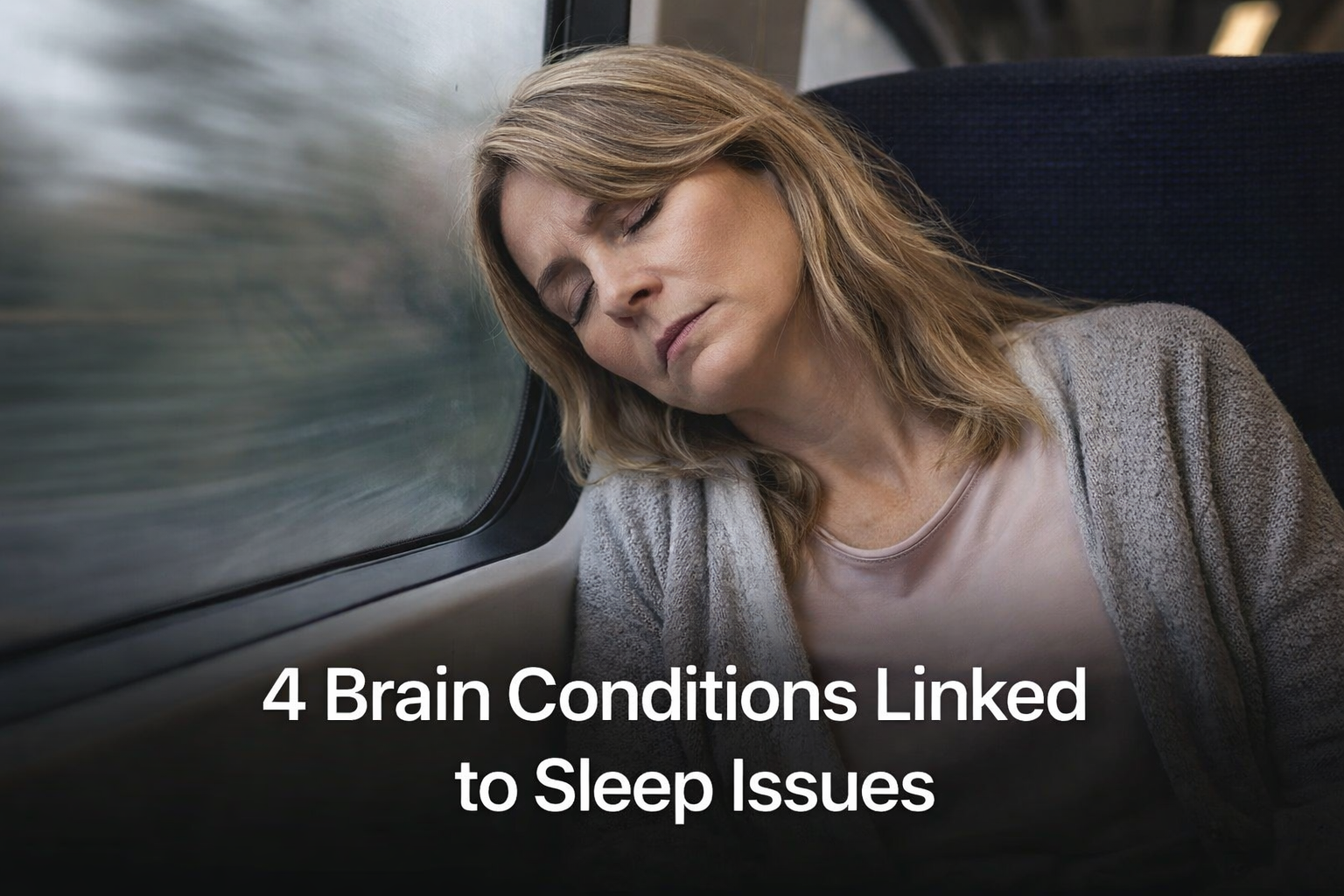
4 Brain Health Conditions Linked to Sleep Issues
Although brain health conditions affect sleep, the reverse is also true. When you aren’t getting enough rest, your brain can’t heal and recover from the stresses of the day. In fact, many mental health issues result from sleep deprivation, insomnia, and other sleep problems.
When you’re tired, several neurological functions are affected, including memory, problem-solving skills, coordination, and focus. The longer your sleep issues persist, the worse these functions become. Altering your sleep patterns or seeking treatment may reduce or eliminate these symptoms. Knowing which conditions are frequently connected to sleep is also vital, so keep reading.
Brain Health Conditions Linked to Sleep Disorders
When the body sleeps, the brain remains active. It relaxes the muscles, slows the heart rate, and lowers the body temperature 1. According to studies, the brain also reorganizes and heals itself, flushing out toxins that have accumulated during the day 2.
Without proper sleep, the brain can’t perform these tasks, risking or worsening dementia, OCD, schizophrenia, or seasonal affective disorder (SAD). The following conditions are the most common brain health conditions triggered by sleep issues.
1. Chronic headaches
According to experts, tension headaches often occur after insufficient or broken sleep 3. However, several headache issues are associated with poor night’s rest.
Studies show that migraines, cluster headaches, hypnic headache, and paroxysmal hemicranias are linked to sleep issues 4. Migraines may occur after insufficient or poor-quality rest. Cluster headaches are influenced by melatonin levels during sleep.
Certain sleep issues may also increase the risks of these brain health conditions. Insomnia, sleep apnea, exploding head disorder, and even oversleeping may trigger severe or chronic head pain 5.
2. Depression and anxiety
Depression is a common brain health issue that has recently been linked to sleep conditions. Those with this disorder often report insomnia, which often worsens their symptoms.
However, the reverse is also true, showing a bidirectional relationship between sleep and depression. Recent studies show that 14% of individuals with insomnia develop depression approximately 1 year later 6.
Anxiety and sleep have a similar relationship. Though anxiety may keep you awake, difficulty falling asleep may cause anticipatory anxiety 7. The fear of being unable to sleep prevents you from doing so, worsening your symptoms.
3. Stroke
Strokes occur when arterial blockage disrupts circulation to the brain or from sudden bleeding in the brain 8. Although common risk factors include high blood pressure, inactivity, or obesity, sleep issues may also contribute to this brain health condition.
According to experts, over 50% of stroke patients are believed to have sleep problems 9. They also state that over 70% of survivors are believed to have obstructive sleep apnea.
Not only do these nighttime issues contribute to the initial stroke, but they also slow recovery. They may also increase the risk of future attacks.
4. Bipolar
Although experts don’t know the exact cause of bipolar disorder, several factors are possible contributors 10. Genetics, environment, or mental health concerns are possible triggers.
However, recent studies have linked sleep problems to this brain health condition 11. It’s believed that an altered circadian rhythm may trigger BP onset or progression. Sleep deprivation frequently occurs during manic episodes as the need for sleep is reduced.
Unfortunately, lack of sleep may also provoke a manic state. This leads to further sleep disturbances, even when the individual shifts to a depressive state, causing insomnia or hypersomnia.
Resources:
- NIH, Brain Basics: Understanding Sleep
https://www.ninds.nih.gov/health-information/public-education/brain-basics/brain-basics-understanding-sleep - PMC, Niv. 18, 2015, The Neuroprotective Aspects of Sleep
https://pmc.ncbi.nlm.nih.gov/articles/PMC4651462/ - PubMed, Aug. 1990
https://pubmed.ncbi.nlm.nih.gov/2245462/ - PubMed, May 2019, Sleep disoder-related headaches
https://pubmed.ncbi.nlm.nih.gov/30906963/ - Cleveland Clinic, Feb. 3, 2023, Here’s Why You’re Always Waking Up With Headaches
https://health.clevelandclinic.org/waking-up-with-a-headache - PMC, Sept. 2008, Sleep disorders as core symptoms of depression
https://pmc.ncbi.nlm.nih.gov/articles/PMC3181883/ - Sleep Foundation Oct. 9, 2025, Anxiety and Sleep
https://www.sleepfoundation.org/mental-health/anxiety-and-sleep - NIH, Stroke Causes and Risk Factors
https://www.nhlbi.nih.gov/health/stroke/causes - American Heart Association, May 2, 2019, The often-overlooked connection between sleep troubles and stroke
https://www.heart.org/en/news/2019/05/02/the-often-overlooked-connection-between-sleep-troubles-and-stroke - Johns Hopkins Medicine, Bipolar Disorder
https://www.hopkinsmedicine.org/health/conditions-and-diseases/manic-depression–bipolar-disorder - Frontiers, July 17, 2019, Sleep Disturbance in Bipolar Disorder: Neuroglia and Circadian Rhythms
https://www.frontiersin.org/journals/psychiatry/articles/10.3389/fpsyt.2019.00501/full
This article is for educational and informational purpose only and does not substitute for professional medical advice. For any questions about your own health condition, speak to a qualified physician or healthcare provider.











Leave A Comment